Organized in the context of the eleventh session of the General Assembly of the States Parties to the 2003 Convention (17 to 18 June 2026, UNESCO headquarters), this information and exchange meeting will present the Convention’s capacity-building approaches as a key support for Member States in ratifying and implementing the Convention, in line with the Intergovernmental Committee’s decision at its twentieth session to maintain capacity-building as a funding priority for the quadrennium 2026-2029 (Decision 20.COM 13).
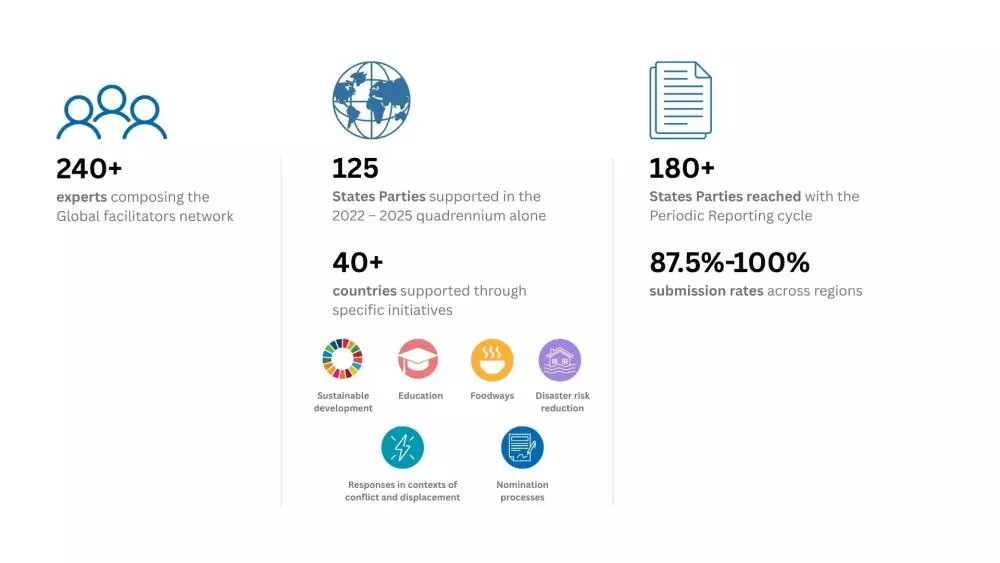
Capacity-building has been central to implementing the 2003 Convention since the launch of the global capacity-building strategy in 2009, supported by voluntary supplementary contributions to the Fund for the Safeguarding of the Intangible Cultural Heritage of the 2003 Convention. Since then, capacity-building interventions undertaken under the Convention have strengthened the safeguarding of living heritage across all regions through tailored support delivered by members of the global facilitators network, which has grown from a small core group to over 240 experts. In the 2022 – 2025 quadrennium alone, it has supported over 125 States Parties in strengthening policies and safeguarding frameworks, as well as more than 40 countries through specific initiatives linking intangible cultural heritage with sustainable development, education, foodways and disaster risk reduction. It has also enhanced capacities in nomination processes, responses in contexts of conflict and displacement, and periodic reporting (the latter reaching over 180 States Parties, with submission rates ranging between 87,5% to 100% across regions).
Objective
The meeting aims to demonstrate how Member States can access and benefit from the programme’s capacity-building approaches with particular attention to:
- Recent developments and innovative initiatives which reflect increasingly flexible, multi-modal modalities (including the UNESCO Learning Platform for Safeguarding of Intangible Cultural Heritage launched in May 2025).
- The role and functioning of the global facilitators network as the operational backbone of implementation support. It will highlight tools and opportunities for engagement.
- The future directions of Funding Priority A (2026-2029) ‘Enhancing capacity-building approaches for safeguarding intangible cultural heritage with a focus on human well-being and community empowerment’, which places inclusion at its core and seeks to further strengthen the global facilitators network, amongst others.

