Rapport sur l'état d'un élément inscrit sur la liste du patrimoine culturel immatériel nécessitant une sauvegarde urgente
A. Page de couverture
A.1.
État partie
Nom de l'État partie
Viet Nam
A.2.
Date du dépôt de l'instrument de ratification, d'acceptation, d'approbation ou d'adhésion
Elle peut être consultée en ligne.
Date of deposit of the instrument of ratification, acceptance, approval or accession
2005-09-20
A.3.
Élément inscrit sur la Liste de sauvegarde urgente qui fait l'objet du présent rapport
Nom de l'élément
Ca trù singing
Inscrit en
2009
État(s) soumissionnaire(s)
Viet Nam
A.4.
Période considérée dans le présent rapport
Veuillez indiquer la période couverte par le présent rapport.
Reporting period covered by this report
01-01-2022 - 01-12-2025
A.5.
Autres éléments inscrits sur la Liste de sauvegarde urgente, le cas échéant
Veuillez établir une liste de tous les autres éléments présents sur le territoire de votre pays qui sont inscrits sur la Liste de sauvegarde urgente et indiquer en quelle année ils y ont été inscrits ; pour ce qui est des éléments multinationaux, veuillez indiquer quels autres États sont concernés.
Other elements inscribed on the Urgent Safeguarding List, if any
L’art de la poterie du peuple Chăm (2022)
A.6.
Synthèse du rapport
Veuillez fournir une synthèse du rapport, qui permette au grand public de comprendre l'état actuel de l'élément, mentionne toute incidence positive ou négative de son inscription et fasse état des mesures de sauvegarde mises en œuvre pendant la période considérée et leur possible mise à jour les années suivantes.
Executive summary of the report
1. Current Status of the Element
Ca trù continues to serve important socio-cultural functions. Beyond fostering community cohesion and preserving values, its role has expanded into intercultural dialogue, education, and tourism. The art form is gradually transitioning from a ritualistic and elite performance to one more accessible to the public.
However, its vitality varies significantly by region. Positive trends are evident in localities like Hà Nội, Quảng Trị, Hải Phòng, Hà Tĩnh, Bắc Ninh, and Hưng Yên, where active club networks, strengthened transmission, and a rejuvenating practitioner base are observed.
Conversely, persistent challenges remain in areas such as Nghệ An, Ninh Bình, Phú Thọ, and Hồ Chí Minh City, characterized by a limited and ageing practitioner pool, irregular activities, and a lack of successors.
Key risks to viability include:
The art's scholarly and demanding nature, requiring long training and limiting youth appeal.
The advanced age of master practitioners, risking disruption to core knowledge transmission.
The shift from a livelihood-based profession to a heritage practice focused on public performance, alongside difficulties in integrating into contemporary life and attracting young audiences.
A lack of stable, dedicated spaces for practice and performance.
2. Impacts of Inscription and Implementation of Safeguarding Measures (2022–2025)
UNESCO inscription has significantly raised public awareness and elevated Ca trù's status. Implemented safeguarding measures during this period yielded positive outcomes.
Organization and Human Resources: The national club network expanded, with 22 clubs in Hà Nội and 10 in Quảng Trị. Numerous transmission classes attracted hundreds of learners. Supportive policies for practitioners were issued, notably Hà Nội's Resolution No. 23.
Promotion & Valorisation: Festivals and performances were organized. Ca trù was introduced into schools, tourist sites, and festivals. Communication efforts increased, and new lyric creation was encouraged.
Research & Support: Documentation and inventory work advanced. Clubs received musical instruments and equipment.
These measures proved particularly effective in proactive localities like Hà Nội, Quảng Trị, and Hải Phòng, helping stabilize and gradually revitalize the element. However, overall impact remains uneven. Challenges related to practitioners' sustainable livelihoods and long-term youth engagement persist. Many activities remain project-based and heavily reliant on State funding.
Communities, including practitioners and clubs, actively participated as core actors in practice and transmission, supported by authorities, educational institutions, experts, and, to a lesser extent, businesses. However, their involvement in planning and monitoring processes is still limited.
Viet Nam recognizes the requirements for safeguarding elements on the Urgent Safeguarding List and commits to implementing more concrete and effective programmes in the next cycle.
3. Adjustments to the Safeguarding Plan for the Next Period (2026–2029)
The updated plan shifts focus from "emergency safeguarding" to "sustainable valorisation," addressing three main areas:
Strengthening Human Resources: Through in-depth transmission programmes, standardized teaching materials, and more systematic integration into formal education.
Enhancing Contemporary Relevance: By developing Ca trù as a distinctive cultural-tourism product, expanding digital outreach to youth, and establishing stable performance venues.
Improving Institutional Frameworks: By implementing the 2024 Cultural Heritage Law for UNESCO-inscribed heritage, refining support policies for practitioners and clubs, and strengthening scientific research.
In summary, Ca trù stands at a critical juncture: while consolidated in several regions, it remains at risk of decline in others. Future success depends on moving beyond campaign-based activities toward long-term solutions focused on systematic training, sustainable livelihoods linked to the heritage, and a community-centred approach in all decision-making processes.
A.7.
Personne à contacter pour la correspondance
Donnez le nom, l'adresse et les coordonnées d'une personne à qui toute correspondance concernant le rapport doit être adressée.
Titre (Mme/M., etc.)
Ms
Nom de famille
Duong
Prénom
Thi Anh
Institution/fonction
Department of Cultural Heritage, Ministry of Culture, Sports and Tourism of Viet Nam/Official
Adresse
51 Ngô Quyền street, Cửa Nam ward, Ha Noi, Viet Nam
Numéro de téléphone
84.915 021 357
Adresse électronique
anhmiew@gmail.com
Autres informations pertinentes
B
Ms
B. État de l'élément inscrit sur la Liste de sauvegarde urgente
Veuillez vous référer au dossier de candidature ou aux précédents rapports, le cas échéant, pour savoir quand établir un rapport sur l'état actuel de l'élément et ne rendez compte que des changements pertinents survenus depuis la date de son inscription sur la Liste ou depuis le précédent rapport. Les dossiers de candidature, les calendriers spécifiques et les précédents rapports, le cas échéant, sont disponibles à l'adresse suivante : https://ich.unesco.org ou peuvent être demandés au Secrétariat.
L'État partie s'efforce de prêter une attention particulière au rôle du genre et d'assurer la plus large participation possible des communautés, des groupes et, le cas échéant, des individus concernés ainsi que des organisations non gouvernementales pertinentes pendant le processus de préparation de ce rapport ; il lui est demandé au point D ci-dessous de décrire de quelle manière il y est parvenu.
B.1.
Fonctions sociales et culturelles
Expliquez les fonctions, les significations sociales et culturelles de l'élément aujourd'hui, au sein et pour ces communautés, les caractéristiques de ses détenteurs et de ses praticiens et décrivez, entre autres, toute catégorie de personnes exerçant un rôle ou des responsabilités spécifiques vis-à-vis de l'élément. Une attention particulière devrait être accordée à tout changement pertinent susceptible d'avoir des répercussions sur le critère d’inscription U.1 (« L’élément est constitutif du patrimoine culturel immatériel tel que défini à l'article 2 de la Convention »).
Social and cultural functions
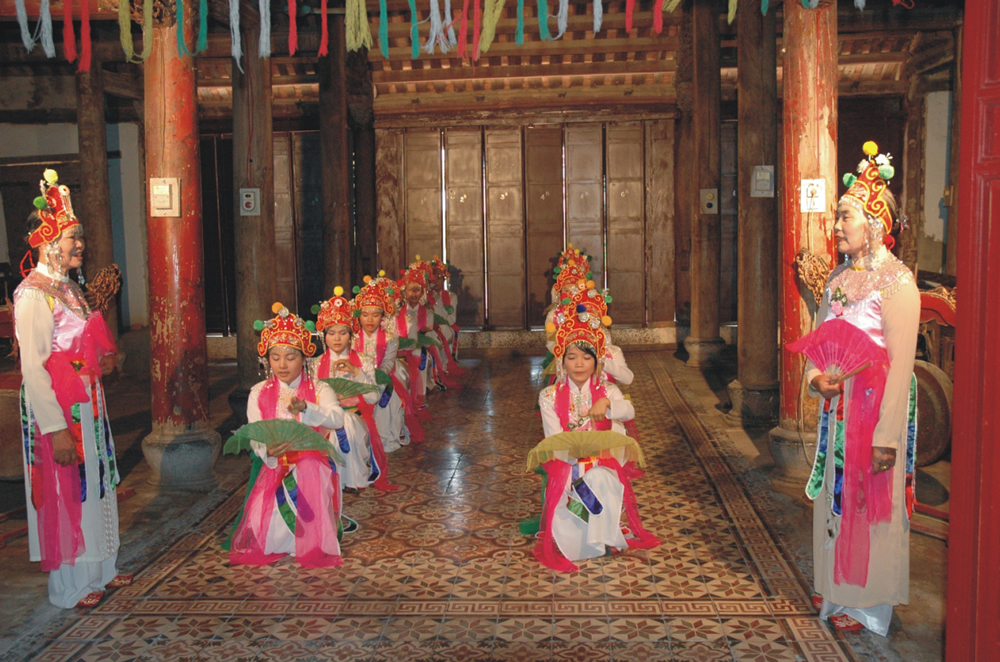
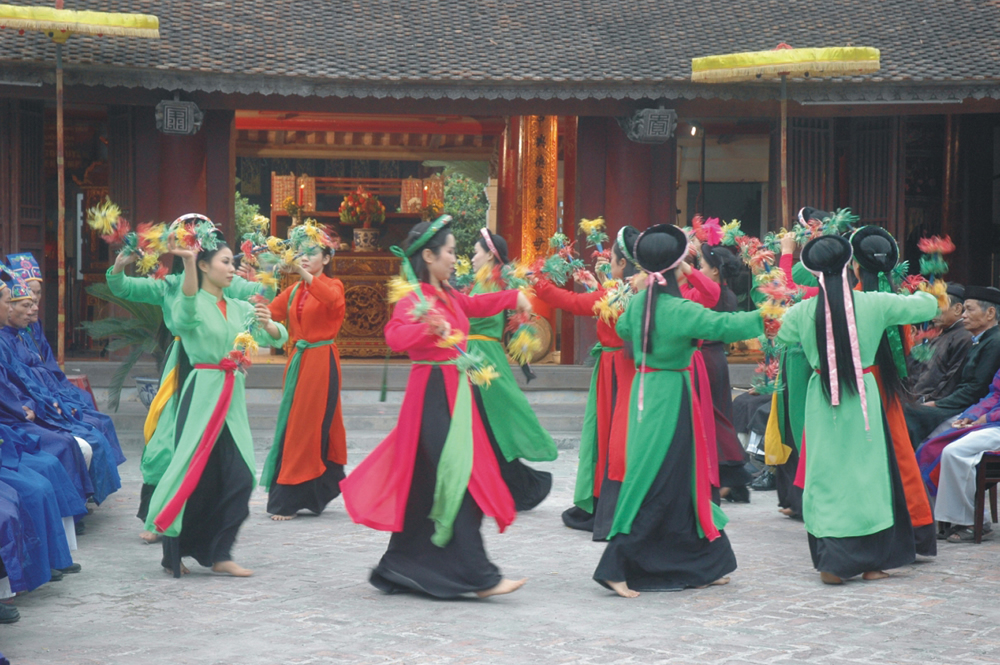
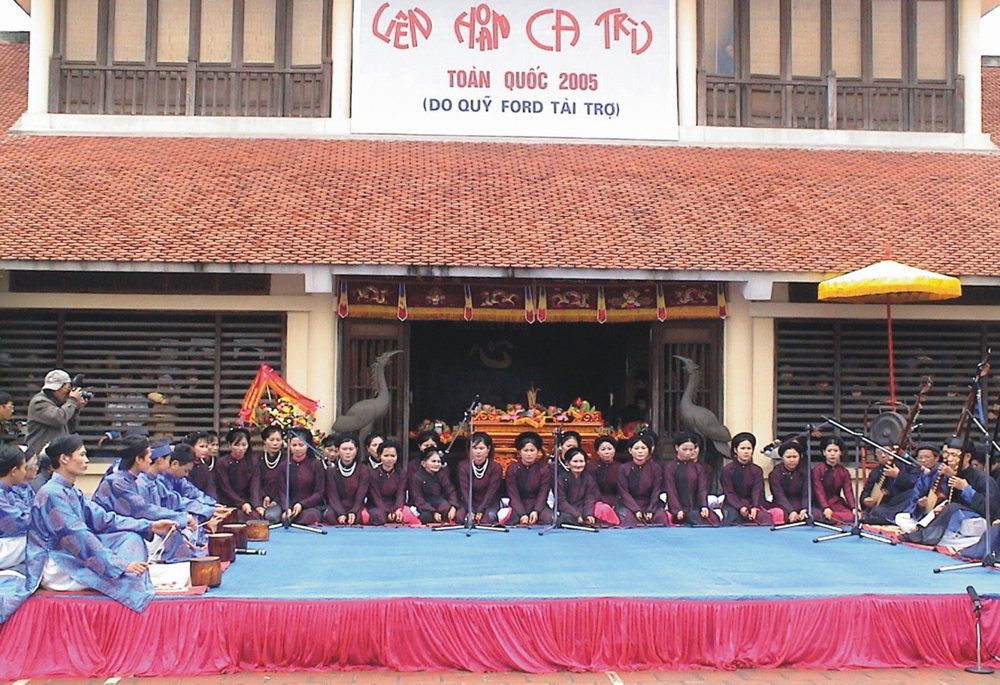
Ca trù is a traditional Vietnamese cultural and artistic practice that has long contributed to community cohesion and to educating successive generations about gratitude to ancestors and respect for their origins. This is particularly expressed through Hát cửa đình (communal house singing), performed in worship of village tutelary deities, ancestors and founders of the craft, and practised in 11 provinces and cities where Ca trù exists.
In community life, Ca trù is also performed in various other forms, including Hát Thờ (ritual singing), Hát Chơi (recreational singing), Hát Chúc Hỗ (ceremonial congratulatory singing) and Hát Thi (competitive singing). Historically, Ca trù was also performed in royal and courtly settings on special ceremonial occasions.
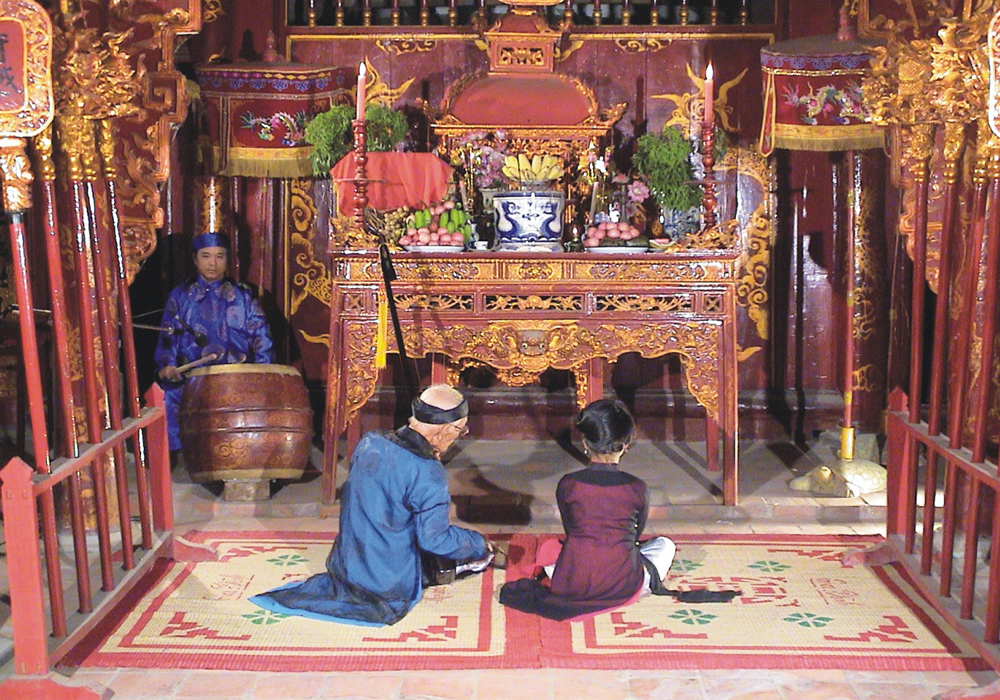
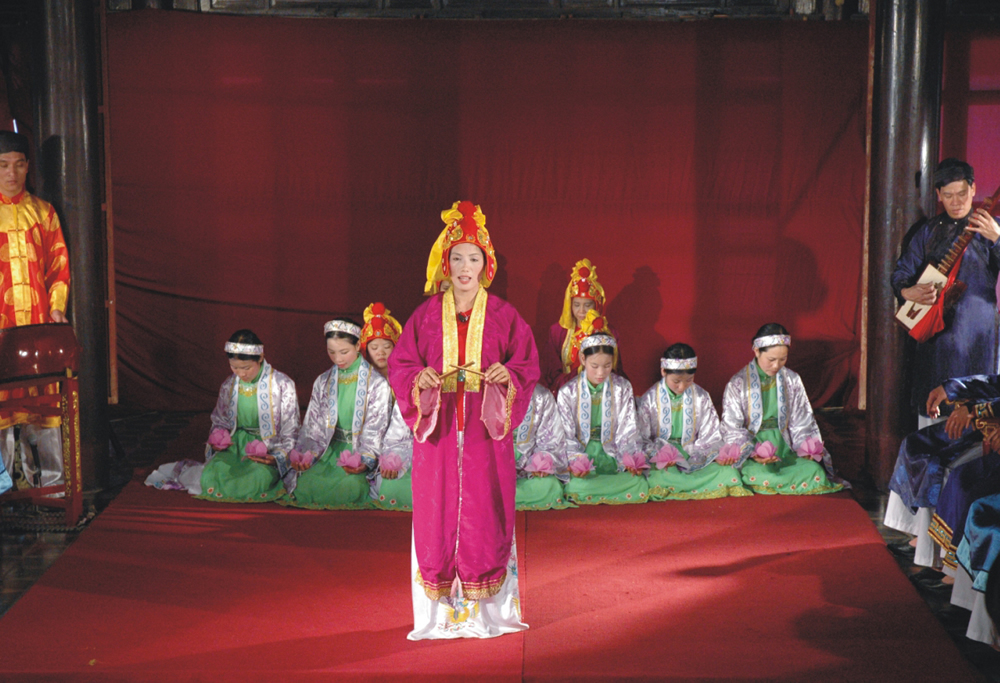
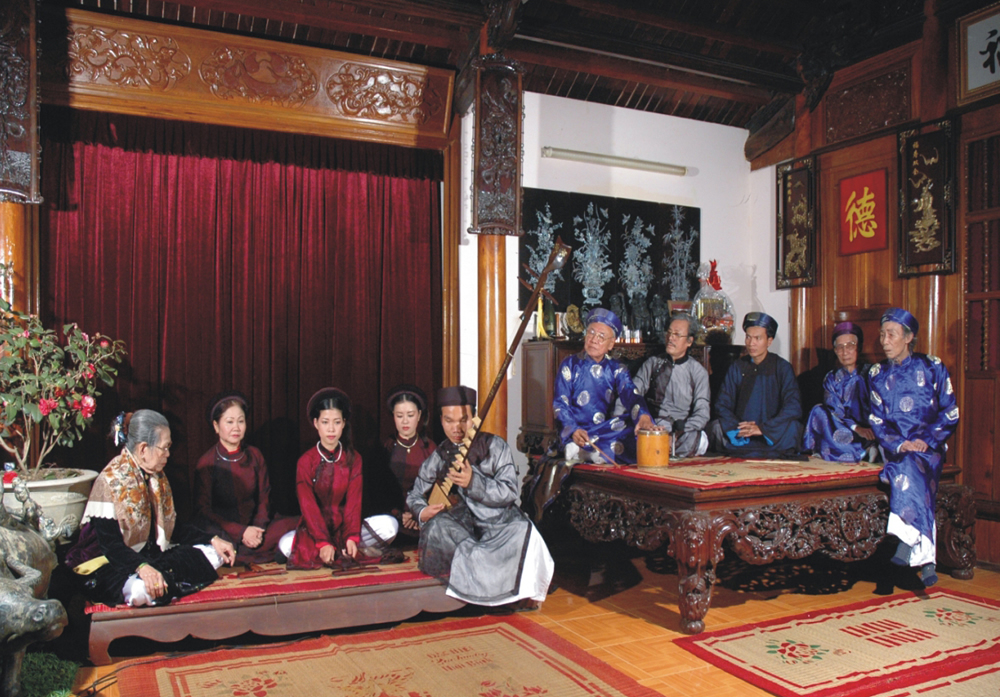
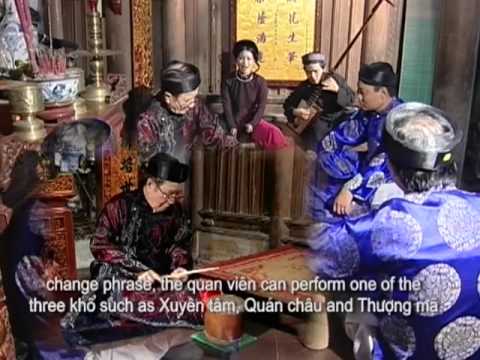
Today, following its revival, Ca trù is not only appreciated by Vietnamese audiences but has also become an art form chosen by many international visitors when travelling in Viet Nam. Traditionally, a Ca trù performing group (or giáo phường) consisted of one đào nương who sang while striking wooden clappers (phách), one kép playing the đàn đáy (three-stringed lute), and one quan viên playing the trống chầu (praise drum), who also commented on and evaluated the artistic quality of the performance. At present, the trống chầu drummer is regarded as an official member of each Ca trù practice group.
Ca trù melodies, known as thể cách, are formed through the close combination of two elements: music and poetry. Ca trù practitioners, including đào nương and kép đàn, must undergo long and rigorous training of a professional nature in order to master the vocal techniques, such as ornamented syllabic articulation, and instrumental techniques, including vibrato, accentuation and rhythmic modulation, in accordance with the stylistic characteristics of the genre.
In the past, Ca trù guilds were led by ông trùm or bà trùm. Today, these positions have been replaced by club leaders or directors of Ca trù centres who possess extensive knowledge and experience of the art. Formerly, Ca trù was practised mainly in communal houses, royal courts or official venues. Today, its performance spaces have expanded to include cultural centres, clubs, radio and television broadcasts, festival and competition stages, as well as performances serving cultural tourism, presented through both traditional repertoires and adapted forms.
Contemporary audiences have gradually developed a deeper understanding and appreciation of Ca trù. After several decades of decline, the heritage has received increasing attention from various sectors of society for its revival and recognition, and it is now appearing more frequently in contemporary cultural life.
B.2.
Analyse de sa viabilité et risques auxquels il est actuellement exposé
Décrivez le degré actuel de viabilité de l'élément, en particulier la fréquence et l'étendue de sa pratique, la vigueur des modes de transmission traditionnels, la composition démographique des praticiens et des publics, et sa durabilité. Veuillez aussi identifier et décrire les facteurs qui, le cas échéant, constituent une menace pour la pérennité de la transmission et de la représentation de l'élément et indiquez le degré de gravité et de proximité de tels facteurs, en accordant une attention particulière à tout renforcement ou affaiblissement de la viabilité de l'élément suite à son inscription.
Assessment of its viability and current risks
Current viability of Ca trù
The current viability of Ca trù shows clear disparities among localities. Several provinces and cities, including Hà Nội, Bắc Ninh, Hà Tĩnh, Hải Phòng, Hưng Yên and Quảng Trị, demonstrate positive signs of recovery and development. In these areas, the element is maintained on a regular basis through networks of Ca trù clubs with weekly or monthly activities. The frequency and scope of practice have expanded beyond traditional communal houses and temples to festivals, cultural events, tourist sites and schools.
Transmission activities have been diversified, combining traditional master–apprentice methods with structured training classes organised by provincial Departments of Culture, Sports and Tourism/Departments of Culture and Sports, with the participation of lecturers from the Viet Nam National Academy of Music and Ca trù heritage specialists. Encouragingly, the practitioner community has shown signs of rejuvenation, with the participation of pupils and students alongside elderly master practitioners. Audiences have also gradually expanded, attracting more young people and intellectuals.
However, in other localities such as Hồ Chí Minh City and the provinces of Ninh Bình, Phú Thọ and Nghệ An, the viability of the element remains seriously threatened. The number of practitioners is small and ageing, practice activities are irregular, and there is little or no successor generation. In these areas, sustainability is extremely fragile and depends almost entirely on elderly master practitioners.
Overall, since its inscription by UNESCO, the viability of Ca trù has been strengthened through increased awareness, expanded transmission and more frequent performances. Nevertheless, these improvements remain uneven and insufficient to fully prevent the risk of decline in many localities.
Threats, severity and urgency
Ca trù continues to face common threats that require urgent intervention.
First, its highly scholarly nature and limited accessibility constitute the most significant barrier. The use of Sino-Vietnamese lyrics, complex artistic techniques and long training periods (from three to ten years) make Ca trù difficult for young people to approach and pursue, resulting in a serious shortage of successors.
Second, the advanced age of master practitioners and the risk of disruption in transmission remain critical concerns. Many “Living Human Treasures” who hold core knowledge and skills are gradually passing away. Although successor generations exist in some localities, their professional depth remains limited, creating the risk of losing rare traditional thể cách and melodies.
Third, financial constraints and livelihood difficulties persist. Most Ca trù clubs rely on limited State funding and member contributions. Practitioners generally cannot earn a stable living from the practice, undermining long-term sustainability.
Finally, there is a lack of stable practice spaces and regular performance opportunities. Traditional performance spaces such as communal houses and temples are increasingly underused, while new venues remain limited, narrowing the environment for the element’s development.
These threats are highly urgent and require fundamental and sustainable safeguarding measures, focusing on systematic training, livelihood creation and audience development to ensure the long-term viability of Ca trù.
B.3.
Mise en œuvre des mesures de sauvegarde
Veuillez rendre compte des mesures de sauvegardes qui ont été décrites dans le dossier de candidature et dans un précédent rapport, le cas échéant. Décrivez de quelle manière elles ont été mises en œuvre et ont contribué de façon substantielle à la sauvegarde de l'élément au cours de la période considérée, en tenant compte des contraintes externes ou internes telles que des ressources limitées. Incluez en particulier des informations sur les mesures prises afin d'assurer la viabilité de l'élément en permettant à la communauté d'en poursuivre la pratique et la transmission. Fournissez les renseignements suivants en ce qui concerne la mise en œuvre de l’ensemble des mesures de sauvegarde ou du plan de sauvegarde :
B.3.a.
Objectifs et résultats
Indiquez quels objectifs principaux ont été atteints et quels résultats concrets ont été obtenus pendant la période considérée.
Objectives and results
During the period 2022–2025, local authorities actively implemented safeguarding objectives and achieved a number of concrete results, contributing to the maintenance and revitalisation of the viability of the element.
1. Organisation and human resources
Objective: To consolidate the network of Ca trù clubs, train successor generations, and support and honour practitioners.
Key results:
Development of club networks: Core practitioner groups of significant scale were established and maintained in many localities. Typical examples include Hà Nội (22 clubs), Hà Tĩnh (2 clubs with approximately 60 practitioners), Quảng Trị (10 clubs), Hải Phòng (10 clubs and one giáo phường), and Bắc Ninh (at least 10 clubs). Even in localities facing greater difficulties, such as Ninh Bình and Phú Thọ, efforts were made to sustain a small number of clubs.
Training of successor generations: Dozens of transmission classes were organised nationwide, attracting hundreds of learners of different age groups. The introduction of Ca trù into schools (e.g. Hải Phòng and Ninh Bình) and the organisation of introductory classes (e.g. Hà Tĩnh) proved to be effective approaches for engaging younger generations. Several localities successfully trained new practitioners; for example, Hà Tĩnh trained an additional three ca nương, two kép đàn and two quan viên.
Support and recognition of practitioners: Various specific support policies were promulgated, notably Hà Nội’s Resolution No. 23, as well as resolutions adopted by Hải Phòng and Hưng Yên. Efforts to nominate practitioners for State titles such as “People’s Artisan” and “Meritorious Artisan” were intensified; in Hà Tĩnh alone, 13 practitioners were awarded these titles.
2. Promotion and valorisation
Objective: To raise community awareness, expand audiences, and promote the value of Ca trù through performance and creative activities.
Key results:
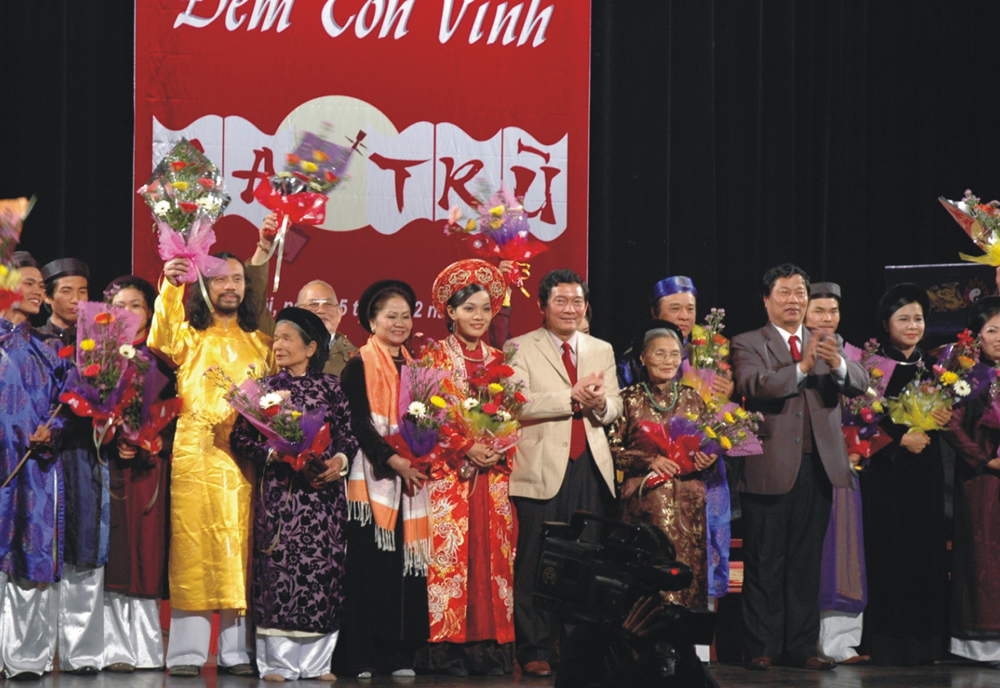
Organisation of cultural events: Large-scale festivals and performances were organised, including the Hanoi Ca trù Festival (3rd edition in 2022 and 4th edition in 2025) and the expanded Ca trù Festival in Hải Phòng (2023). Other provinces actively integrated Ca trù into local festivals (e.g. Nghệ An), Heritage Nights (Phú Thọ) and various cultural events.
Expansion of performance spaces: Ca trù moved beyond traditional indoor performance settings and appeared at tourist sites (e.g. Thanh Hóa and Hưng Yên) and in public spaces, increasing accessibility for wider audiences.
Communication and creativity: Communication activities were strengthened, and the creation of new lyrics (over 30 works in Hà Tĩnh) reflected efforts to adapt the heritage to contemporary contexts.
3. Material support and research
Objective: To conduct inventorying and documentation and to provide equipment and musical instruments.
Key results: Several localities carried out inventorying, audio and video recording of master practitioners (e.g. Hải Phòng and Bắc Ninh). Ca trù clubs were supported with musical instruments and costumes, improving conditions for practice and transmission.
B.3.b.
Activités de sauvegarde
Dressez la liste des principales activités menées au cours de la période considérée pour obtenir ces résultats escomptés. Veuillez décrire les activités en détail en mentionnant leur efficacité et tout problème rencontré dans leur mise en œuvre.
Safeguarding activities
1. Transmission and training
Transmission and training were prioritised, designed in diverse forms to reach different audiences.
Implementation forms:
Intensive training classes: Provinces such as Hà Nội, Quảng Trị and Bắc Ninh organised short-term and long-term courses at Cultural Centers, with lecturers from the Viet Nam National Academy of Music participating (Bắc Ninh).
School-based transmission: Hải Phòng and Ninh Bình pioneered the introduction of Ca trù into extracurricular programs from primary to lower secondary education.
Community transmission: Hà Tĩnh maintained both introductory and advanced classes; Hưng Yên organised structured courses according to plans of the Department of Culture, Sports and Tourism.
Training for artistic units: Phú Thọ invited master practitioners from Hà Nội to train the provincial Art Troupe.
Results and challenges:
Results: Hundreds of learners of various ages were attracted, contributing to the rejuvenation of the practitioner community. School programs generated initial interest among young audiences.
Challenges: Effectiveness remains uneven. In provinces such as Nghệ An and Thanh Hóa, teaching is hindered by a lack of students, and drop-out rates are high. Bắc Ninh faces shortages of skilled masters for transmission.
2. Performance activities
Performances provide essential practice environments, opportunities for exchange, and public promotion of the element.
Implementation forms:
Large-scale festivals and competitions: Organised in Hà Nội, Hải Phòng, and Hưng Yên.
Community performances: Clubs performed at festivals, cultural and political events.
Integration with tourism: Thanh Hóa and Hưng Yên incorporated Ca trù into tourist attractions.
Open-space performances: Quảng Trị expanded performances into public and mass-art programs.
Results and challenges:
Results: Provided essential practice spaces, maintained skills and enthusiasm of practitioners, while raising awareness and expanding audiences.
Challenges: Activities remain seasonal and event-dependent. In Ninh Bình and Phú Thọ, stable performance venues and regular performance opportunities are limited.
3. Research, documentation, and communication
Research and documentation, along with communication, aim to safeguard and promote the heritage’s value.
Implementation forms:
Inventorying and documentation: Conducted in Hải Phòng, Bắc Ninh, Hưng Yên, and Hà Nội through interviews, video and audio recording, and collection of documents.
Multimedia communication: Produced reports and documentaries broadcast on television and in the press.
Publication and printing: Hà Tĩnh published reference materials and produced DVDs and CDs.
Results and challenges:
Results: Preserved valuable knowledge from elder masters, created a database for research and teaching, and increased social awareness.
Challenges: Activities remain fragmented and lack a comprehensive national system. Documentation in many localities has not been systematically developed. Media coverage has limited impact on younger audiences.
4. Material support, investment, and policy development
These activities create mechanisms and resources for safeguarding.
Implementation forms:
Legal framework: The 2024 Law on Cultural Heritage provides a legal basis. Relevant documents include Government Decrees No. 215/2025/ND-CP and No. 308/2025/ND-CP detailing the management, safeguarding and promotion of intangible cultural heritage.
Practitioner support policies: Issued in Hà Nội, Hà Tĩnh, Hưng Yên, and Nghệ An.
Material support: Investment in musical instruments, costumes, and operational funding for clubs.
Recognition of practitioners: Review and nomination for honorary titles.
Results and challenges:
Results: Strong material and moral incentives strengthened practitioners’ attachment to the art.
Challenges: Funding remains limited, insufficient to resolve livelihood issues.
5. Organisational consolidation and social mobilisation
These measures strengthen community foundations and diversify resources.
Implementation forms:
Club network consolidation: Supported the establishment and maintenance of clubs (Ninh Bình, Quảng Trị).
Social mobilisation: Sought sponsorship from enterprises and individuals (Hà Tĩnh, Quảng Trị) and linked activities with tourism (Hưng Yên).
Results and challenges:
Results: Built solid community foundations and mobilised resources beyond State budgets.
Challenges: Social mobilisation remains modest, and administrative restructuring initially complicated coordination among clubs.
Overall, safeguarding activities in 2022–2025 demonstrated a comprehensive approach—from training and research to performance, communication, and policy development. These measures achieved positive results, especially in proactive provinces such as Hà Nội, Quảng Trị, and Hải Phòng, contributing to the consolidation and gradual revitalisation of the element.
However, results are uneven. Many activities remain “campaign-based,” heavily dependent on State funding, and have not fully addressed core challenges: providing sustainable livelihoods for practitioners, attracting younger generations, and expanding audiences. The next period will require breakthrough measures, focusing on generating economic value from the heritage and innovative approaches, particularly targeting youth engagement.
B.3.c.
Participation de communautés, de groupes ou d'individus aux activités de sauvegarde
Veuillez décrire de quelle manière les communautés, les groupes ou, le cas échéant, les individus ainsi que les organisations non gouvernementales pertinentes ont participé de façon effective à l'exécution des mesures de sauvegarde, y compris en termes de rôles du genre. Décrivez le rôle joué par l'organisation ou l'organe chargé de l'exécution (dénomination, informations de référence, etc.) et les ressources humaines qui ont été mises à disposition pour la mise en œuvre des activités de sauvegarde.
Participation of communities, groups or individuals in the safeguarding activities
During 2022–2025, the safeguarding of Ca trù was implemented under a cooperative model of “State and people working together,” with diverse participation across multiple levels, creating a comprehensive protection mechanism.
1. The implementation of bearers and their roles
Community: Clubs and master practitioners served as the core actors, directly practising, transmitting, maintaining regular activities, and creating new compositions (e.g., 22 clubs in Hà Nội, 10 clubs in Quảng Trị and Hải Phòng).
Government authorities: State management agencies (Department of Cultural Heritage, Departments of Culture, Sports and Tourism) provided policy advice, coordinated resources, and issued supportive resolutions. Local authorities (communes, wards) offered direct support in funding and venues.
Professional and social organisations: Institutions such as the Viet Nam Academy of Music and the Institute of Culture, Arts, Sports and Tourism provided expert support. Universities—Hanoi University of Culture, Ho Chi Minh City University of Culture, and the School of Interdisciplinary Arts (Vietnam National University, Hanoi)—served as important channels for heritage education. Businesses and social organisations contributed through social mobilisation.
Individuals and spontaneous groups: In major cities, diverse participation included independent art groups, lecturers, and young artists actively promoting the heritage.
2. Gender considerations
Gender issues were addressed in several localities. For example, Hà Nội has flexibly allowed women to assume traditional male roles (such as đàn kép or trống chầu), creating equal opportunities and practically compensating for the shortage of practitioners.
3. Human resources
The main human resources were drawn from the community stakeholders, including master practitioners, club leaders (holding core knowledge and practical skills), and members and learners (practising and successor forces). Professional staff at Departments and cultural centers played managerial and coordinating roles, although many localities still face a shortage of highly specialised personnel.
Overall, the participatory model ensured that safeguarding activities engaged all relevant actors—from the grassroots level to formal institutions—while recognising the importance of gender balance and capacity development. This approach strengthened the community foundation and promoted intergenerational transmission, providing the human resources necessary for sustaining Ca trù in both practice and teaching.
B.3.d.
Calendrier
Indiquez, sous forme de calendrier, les dates de mise en œuvre de chacune des activités.
Timetable
1. Transmission and Training Activities
- Training classes: Held annually (2022-2025) in Bắc Ninh, Hà Tĩnh, Hải Phòng, and Quảng Trị.
- School-based transmission: Conducted each year in Hải Phòng.
- Transmission classes: Opened in Hưng Yên from 2023 through 2025.
- Training workshops: Held in Phú Thọ in 2024.
2. Performance and Seminar Activities
- Ca trù Festivals: Held in Hà Nội in 2022 and 2025.
- Competitions and performances: Staged annually in Bắc Ninh and Quảng Trị.
- Festivals and exchanges: Organized in Hải Phòng and Hưng Yên in 2022, 2023, and 2025.
- Hát nói poetry competitions: Held in Hà Nội in 2023.
- Specialized seminars: Conducted in Hà Nội in 2024.
- Street Festival participation: By Nghệ An in 2023 and 2024.
3. Promotion and Publicity Activities
- Regular promotion: Carried out annually in Hà Nội and Bắc Ninh.
- Television promotion: Broadcast yearly in Hải Phòng (2022-2025).
- Community/tourism performances: Held each year in Hà Tĩnh and Quảng Trị.
- Festival/event performances: Staged annually in Nghệ An.
- Heritage Night performances: In Phú Thọ (2023, 2024).
- Assigned-task performances: Conducted yearly in Phú Thọ.
4. Documentation and Research Activities
• Material collection/documentation: Undertaken annually in Bắc Ninh, Hà Tĩnh, and Hưng Yên (2022-2025).
• Inventorying/documentation: Carried out each year in Hải Phòng.
5. Support and Policy Activities
- Support policies: Issued and implemented annually in Hà Nội, Hà Tĩnh, and Nghệ An.
- Funding for clubs/practitioners: Provided yearly in Hải Phòng and Hưng Yên.
- Instrument/facility provision: Supplied annually in Quảng Trị (2022-2025).
- Plans/policies issued: In Bắc Ninh (2022, 2023).
- Social resource mobilization: Conducted yearly in Hà Tĩnh.
- New clubs established: In Hưng Yên (2023).
- Honorary title proposals: Finalized in Hà Nội (2025).
Continuity: Core activities—including teaching, promotion, funding, and club maintenance—were sustained throughout the period in most localities, demonstrating persistent safeguarding commitment.
Diversity: Activities ranged from large-scale events like festivals and competitions, which created annual highlights and platforms for practitioners, to focused initiatives such as specialized seminars and composition competitions (Hà Nội), reflecting deeper investment in quality and artistic substance.
Annual Focus: The years 2022 and 2025 featured major festivals (Hà Nội). The 2023–2024 period emphasized training, transmission, and documentation. The nomination of practitioners for state honors followed the regular cycle in 2025.
Local Variations: Provinces with stronger foundations (Hà Nội, Hải Phòng, Quảng Trị) maintained denser and more diverse activity schedules. Localities facing greater challenges (Phú Thọ, Nghệ An) had more limited or intermittent activities, primarily focused on festival participation and specific performances.
B.3.e.
Dépenses budgétaires
Veuillez fournir le détail des montants des fonds utilisés pour la mise en œuvre de chaque activité (si possible, en dollars des États-Unis), en indiquant dans chaque cas l’origine du financement (sources gouvernementales, contributions en nature des communautés, etc.).
Budget
During 2022–2025, funding for safeguarding and promoting Ca trù primarily came from two sources:
- State budget (main source): covering key activities such as supporting practitioners, organising events, purchasing equipment, and teaching.
- Community contributions and socialisation (supplementary source): used for regular club activities, heritage site maintenance, and small-scale performances.
Expenditures can be grouped into three main categories, with illustrative figures from selected localities (exchange rate reference: 25,000 VND/USD):
a. Direct support for practitioners and clubs
- Monthly allowances for practitioners:
Hà Nội (Resolution 23): People's Artists: 1.6 million VND/month (64 USD); Meritorious Artists: 1.2 million VND/month (48 USD), based on teaching allowances of 500,000/300,000 VND/session, assuming 2–4 sessions/month.
Nghệ An (Resolution 29): Meritorious Artists: 1,000,000 VND/month (40 USD); People's Artists: 1,500,000 VND/month (60 USD).
Bắc Ninh: People's Artists: 1.8 million VND/month (72 USD); Meritorious Artists: 1.5 million VND/month (60 USD).
Hải Phòng: Support for Meritorious Artist Trương Quang Hiến: 1,000,000 VND/month (40 USD).
- Support for club activities:
Hà Nội: New club establishment: 50 million VND/club (2,000 USD); annual operation support: 20 million VND/club/year (800 USD).
Hà Tĩnh (Resolution 98): 30 million VND/club/year (1,200 USD), total 180 million VND for 2 clubs over 3 years (7,200 USD).
Hải Phòng (former Hải Dương): 5 million VND/club/year (200 USD).
Nghệ An: Active clubs: 5 million VND/year (200 USD); new clubs: 30 million VND (1,200 USD).
b. Event organisation, transmition, and equipment purchase
- Large-scale events: Hà Nội: Each Ca trù festival cost over 300 million VND (≈12,000 USD).
- Training and teaching classes: Hà Tĩnh: 40 million VND (1,600 USD) for intensive training and heritage restoration (2022).
- Equipment support: All localities allocated unspecified funds for musical instruments (đàn đáy) and performance costumes (Hà Tĩnh, Bắc Ninh).
c. Other support
Performance support: Hà Tĩnh provided 20 million VND (800 USD) for artists performing at special occasions (2022–2024).
Heritage protection: Hưng Yên allocated 500–600 million VND/year (20,000–24,000 USD) for safeguarding Ca trù and Trống quân.
Teaching and general club activities: Hải Phòng provided approximately 200 million VND (8,000 USD) in total from 2022–2024.
Overall, these funding arrangements reflect a combination of state and community support, covering essential needs for practitioners, clubs, events, training, and heritage maintenance, while ensuring continuity of Ca trù activities over the reporting period.
B.3.f.
Efficacité globale des activités de sauvegarde
Procédez à une évaluation globale de l'efficacité des activités menées pour parvenir aux résultats escomptés et de l'utilisation des fonds nécessaires à leur mise en œuvre. Veuillez indiquer de quelles manières les activités ont contribué à l’obtention des résultats et si d'autres activités auraient été mieux adaptées à cette fin. Indiquez aussi si les mêmes résultats auraient pu être obtenus avec de moindres ressources financières, si les ressources humaines disponibles étaient appropriées et si les communautés, groupes et individus concernés auraient pu participer davantage.
Overall effectiveness of the safeguarding activities
The effectiveness of safeguarding Ca trù during 2022–2025 varied across localities and can be classified into three main groups:
High Effectiveness (Successful Models): Hà Nội, Quảng Trị, Hải Phòng, Hà Tĩnh, and Hưng Yên. Activities in these areas contributed to stabilizing, gradually restoring, and developing the vitality of the heritage. This success was supported by strong club networks, practical support policies, and large-scale events that reinforced community engagement.
Low Effectiveness (Critical Status): Nghệ An, Ninh Bình, Phú Thọ, Ho Chi Minh City, and Thanh Hóa. Efforts in these regions were largely reactive, unable to prevent declines in the number and quality of practitioners or to attract the next generation. The heritage here still requires urgent protection measures.
Medium Effectiveness: Bắc Ninh represents a middle case. Activities met basic objectives but lacked depth and failed to create breakthroughs in expanding the heritage’s influence.
1. Effectiveness of Fund Utilization
Overall, funding was focused and practical:
The most tangible impact came from direct support for practitioners and clubs (allowances and activity funding), which helped maintain the core workforce.
Funding for large-scale events (festivals and competitions) created platforms for practice, raised public awareness, and discovered new talent, producing positive social effects.
However, resources remain limited compared to needs, and sustainable livelihood for practitioners has not been fully addressed.
2. Assessment of Key Activities and Recommendations
Transmission activities are crucial for attracting the next generation. Integrating Ca trù into schools proved to be a correct approach.
Recommendation: Expand intensive community-based classes under direct guidance of master artists and expert consultation; systematically integrate Ca trù into the general music education curriculum.
Policy development and support provide a legal framework and financial incentives.
Recommendation: Diversify resources through stronger socialisation and community funding mechanisms.
Promotion and practice environment sustain the heritage’s presence.
Recommendation: Develop a structured digital communication strategy targeting youth; strengthen connections with cultural tourism to create experiential products with economic value, contributing to sustainable livelihoods.
3. Assessment of Human Resources and Community Participation
Existing human resources (artists, club leaders) possess relevant knowledge and skills but are aging and experiencing a serious shortage.
Communities actively participate in practice and teaching but are mostly involved in implementation rather than planning, monitoring, and evaluation.
Recommendation: Empower communities to participate in decision-making on resource allocation, enhancing ownership and effectiveness.
In conclusion, safeguarding activities between 2022 and 2025 have consolidated organizational and policy foundations. To achieve sustainable results, focus should shift to more in-depth activities: investing in high-quality formal training and developing livelihood models linked to the heritage, ensuring that Ca trù continues to thrive and attract new generations.
C
Duong
C. Mise à jour des mesures de sauvegarde
C.1.
Plan de sauvegarde mis à jour
Veuillez fournir une mise à jour du plan de sauvegarde inclus dans le dossier de candidature ou dans le précédent rapport. En particulier, veuillez donner des informations détaillées comme suit :
- a. Quels sont les objectifs principaux visés et les résultats concrets attendus ?
- b. Quelles sont les activités principales à mener pour atteindre ces résultats attendus ? Veuillez décrire les activités en détail et dans l'ordre d'exécution, en démontrant leur faisabilité.
- c. Comment le ou les États parties concernés soutiennent-ils la mise en œuvre du plan de sauvegarde mis à jour ?
Updated safeguarding plan
Based on the evaluation of the 2022-2025 implementation period, participating localities have proposed a new strategic orientation for the Ca trù Singing safeguarding plan. This involves shifting the core focus from "emergency safeguarding" to "sustainable promotion".
a. Main Objectives and Expected Outcomes
The new objectives concentrate on three pillars:
Consolidating human resources: Training a quality next generation of practitioners (in Bắc Ninh, Hải Phòng) and reviving endangered performance techniques (in Hà Nội), aiming for a rejuvenated and highly skilled practitioner base.
Connecting with contemporary life: Raising community awareness and integrating the heritage into tourism and education (in Hà Tĩnh, Quảng Trị), transforming Ca trù into a distinctive cultural-tourism product more familiar to the public, especially youth.
Strengthening institutions and infrastructure: Establishing fixed performance spaces (in Hà Nội), perfecting support policies (in Hải Phòng), and developing provincial-level master safeguarding projects (in Thanh Hóa, Nghệ An) to create a stable, long-term environment for the heritage.
b. Key Planned Activities and Feasibility Assessment
The new plan builds upon proven approaches while introducing strategic innovations:
Quality enhancement group: Organising in-depth transmission workshops (Hà Nội), compiling standardized teaching materials, integrating Ca trù into formal/experimental school curricula (Quảng Trị, Hồ Chí Minh City). High feasibility, contingent on close coordination between Culture and Education sectors and stable resources.
Space expansion group: Developing fixed, professional performance venues (Hà Nội) and integrating Ca trù into cultural tourism itineraries (Hưng Yên, Quảng Trị). Feasibility: Medium to High, depending on partnerships with tourism businesses and the ability to create appealing products.
Research and institutionalisation group: Conducting specialised studies (Bắc Ninh), formulating provincial-level master safeguarding projects (Nghệ An), and advocating for specific support policies (Phú Tho). Feasibility: Medium, requiring strong advisory capacity and attention from competent authorities.
c. Supporting Role of the State
The State plays a crucial role through:
Policy and legal support: Specifying safeguarding mechanisms under the 2024 Cultural Heritage Law; supporting master practitioners, clubs, and the development of heritage management and protection projects.
Resource support: Allocating budgets from the National Target Programme on Cultural Development; deploying experts to assist in transmission; organising periodic seminars and festivals for networking and experience sharing.
Promotional support: Facilitating Ca trù participation in international cultural exchange programmes, elevating its profile, and seeking international cooperation opportunities.
The updated plan demonstrates a clearer strategic vision, moving from reactive measures to proactive risk prevention and sustainable value creation. Its success will depend on enhanced regional linkage (to avoid fragmentation), long-term resource commitment, and the promotion of socialisation (community/private sector involvement) to alleviate pressure on the state budget.
C.2.
Calendrier des activités à venir
Veuillez fournir un calendrier du plan de sauvegarde mis à jour (sur une période d’environ quatre ans).
01574
Timetable
The following section details the planned activities by category across the 2026-2029 period.
1. TRANSMISSION & ADVANCED TRAINING ACTIVITIES
- Organizing intensive/advanced transmission workshops each year in Bắc Ninh, Hà Nội, Hà Tĩnh, Hải Phòng, and Hưng Yên.
- Conducting general training, transmission, and capacity-building courses annually.
- Integrating transmission into school curricula every year in Hải Phòng.
- Compiling dossiers for state honorary titles for practitioners, scheduled for 2029.
2. RESEARCH, DOCUMENTATION & POLICY DEVELOPMENT ACTIVITIES
- Reviewing and systematizing archival materials each year in Hải Phòng and Hưng Yên.
- Enhancing scientific research annually in Bắc Ninh.
- Developing teaching materials and instructional videos every year in Hà Nội.
- Conducting research and formulating supportive policies annually in Hải Phòng and Hưng Yên.
- Develop a Provincial Master Safeguarding Plan/Project in Nghệ An, scheduled for completion in 2026.
3. PERFORMANCE ORGANIZATION & EXCHANGE ACTIVITIES
- Organizing competitions, festivals, and exchange events will be held annually in Bắc Ninh.
- Local Ca trù Festivals in Hà Tĩnh and Hưng Yên are planned for 2026 and 2028.
- The major Ca trù Festival in Hà Nội, if following its 3-year cycle, is slated for 2028.
- Seminars to revive specific performance styles (thể cách) will be held in Hà Nội in 2026 and 2028.
- Participation in the National Ca trù Festival will align with the central authority's schedule.
4. COMMUNITY DEVELOPMENT & INFRASTRUCTURE ACTIVITIES
- Establishing new clubs is planned annually from 2026 to 2029 in Bắc Ninh and Hưng Yên.
- Constructing a dedicated performance space in Hà Nội is scheduled for 2027-2029.
- Restoring the Worship House of Ca Công in Lỗ Khê (Hà Nội) is an ongoing project with annual activities through 2030.
- Building/upgrading cultural spaces will occur each year in Bắc Ninh.
5. PROMOTION, DISSEMINATION & PRACTICE MAINTENANCE ACTIVITIES
- Strengthening promotion and dissemination efforts every year in Bắc Ninh and Hưng Yên.
- Conducting television broadcasting campaigns annually in Hải Phòng.
- Maintaining regular club activities and performances each year in Hà Tĩnh.
- Performing Ca trù at the Đền Cuông Festival annually in Nghệ An.
The core activities, including transmission, promotion, maintaining club operations, and research, are sustained throughout the four-year period, demonstrating a sustainable and stable safeguarding strategy.
2026 serves as the launch and foundational year, focusing on developing the provincial master plan (Nghệ An), initiating key training classes, and commencing large-scale research and documentation projects.
2027-2028 represent the intensive implementation phase, accelerating infrastructure development (e.g., the dedicated performance space in Hà Nội), establishing new clubs, and organizing major festivals and events. In-depth training and the revival of specific performance styles (thể cách) are also intensified.
2029 continues to maintain regular activities while shifting focus towards consolidation and review, aiming to assess and conclude the objectives set for the four-year cycle.
Overall, the proposed timeline appears feasible, with a reasonable allocation of both short-term and long-term activities.
C.3.
Budget des activités à venir
Veuillez fournir les estimations des fonds requis pour la mise en œuvre du plan de sauvegarde actualisé (si possible, en dollars des États-Unis), en identifiant les ressources disponibles (sources gouvernementales, contributions en nature des communautés, etc.)
Budget
Although a detailed budget for the next four-year period has not yet been formulated, the participating localities have agreed to continue the combined funding model of state and social resources, with the following specific structure:
1. State Budget (Primary and Stable Resource):
This continues to be identified as the main resource, with clearly defined allocation levels:
Central Budget/Ministry of Culture, Sports and Tourism: Supports large-scale projects, deploys experts, and organizes national-level festivals and performance events.
Provincial/Municipal Budget: Maintains existing support policies (e.g., in Hà Nội, Hưng Yên) and funds province-level activities such as festivals, training workshops, and equipment procurement.
Commune/Ward Budget: Supports regular grassroots activities and minor repairs to community practice spaces (e.g., in Hải Phòng, Nghệ An).
2. Socialized and Community Resources:
Aimed at supplementing funding and gradually reducing reliance on the state budget, this includes:
Internal Contributions: Club members contribute funds to cover costs of regular activities.
External Sponsorship: Mobilizing sponsorship from businesses, organizations, and individuals for specific performances, costume/instrument procurement, or training scholarships (e.g., in Hà Tĩnh, Quảng Trị).
Tourism Revenue: Generating income from integrating Ca trù into community-based tourism tours and itineraries (e.g., in Hưng Yên, Quảng Trị).
This financial structure aims to ensure stable resources for core safeguarding activities while progressively promoting the autonomy and initiative of the community and society.
C.4.
Participation des communautés
Veuillez décrire comment les communautés, groupes et individus ainsi que les organisations non gouvernementales pertinentes ont été impliqués, y compris en termes de rôles du genre, dans la mise à jour du plan de sauvegarde et comment ils seront impliqués dans sa mise en œuvre.
00234
Community participation
The process of updating the Ca trù safeguarding plan for the next phase incorporated community consultation. A notable example is Hà Nội, which proactively conducted surveys and solicited feedback from district cultural departments, clubs, and master practitioners to shape its plan. This approach ensures the plan's practicality and alignment with grassroots needs. Thanh Hóa recorded community input through their proposals for support policies, demonstrating an indirect feedback channel.
Anticipated Roles of Stakeholders in Plan Implementation:
Core-Bearing Community (Clubs, Master Practitioners): Continue to be identified as the central force and primary agents responsible for core activities: transmission, practice, performance, creation, and maintaining regular club operations. Some localities (e.g., Bắc Ninh) also expect them to participate in monitoring implementation.
Government Authorities at All Levels (Departments of Culture, Sports and Tourism/Departments of Culture and Sports, People's Committees, etc.): Serve a supportive, facilitative role by enacting policies, allocating funds, organizing major events, and providing logistical and infrastructural support.
The plan also expands participation to include:
Educational Institutions: Acting as a channel for heritage education and outreach to younger generations (Hồ Chí Minh City, Quảng Trị).
Researchers and Specialists: Providing expert advice and technical consultation (Hà Nội, Bắc Ninh).
Private Enterprises: Offering financial support, performance venues, and contributing to tourism development (Quảng Trị).
Regarding Gender Roles in Plan Implementation: Hà Nội encourages the participation of women in roles traditionally held by men, such as instrumentalists (kép đàn) and rhythm/praise drummers (trống chầu). This is not only a gender equality measure but also a practical solution to address practitioner shortages, implemented with due respect for the art form's integrity.
C.5.
Contexte institutionnel
Veuillez indiquer quelles institutions sont en charge de la gestion locale et de la sauvegarde de l'élément inscrit sur la Liste de sauvegarde urgente, notamment :
- a. l'(les) organisme(s) compétent(s) impliqué(s) dans sa gestion et/ou sa sauvegarde ;
- b. l'(les) organisation(s) de la communauté ou du groupe concernée(s) par l'élément et sa sauvegarde.
2005-09-20
Institutional context
a. Government Agencies Involved in Management and Safeguarding
The Department of Cultural Heritage (Ministry of Culture, Sports and Tourism) is the state management agency for cultural heritage at the national level.
The People's Committees of the provinces/cities of Hà Nội, Bắc Ninh, Hà Tĩnh, Hải Phòng, Hồ Chí Minh City, Hưng Yên, Nghệ An, Ninh Bình, Phú Thọ, Quảng Trị, and Thanh Hóa have the role of providing overall direction and approving major policies and plans.
Local Management Agencies: The provincial/municipal Departments of Culture, Sports and Tourism or Departments of Culture and Sports.
Coordinating/Implementing Agencies: These include subordinate units of the Departments (such as Cultural Centers, Theaters), commune/ward People's Committees, and other relevant departments.
b. Community Organizations
These consist of Ca trù Clubs and Guilds (giáo phường) in the 11 provinces and cities where the art of Ca trù singing is practiced.
D
Thi Anh
D. Participation des communautés à l'établissement du présent rapport
Décrivez les mesures qui ont été prises pour assurer la plus large participation possible des communautés, des groupes et, le cas échéant, des individus ainsi que des organisations non gouvernementales pertinentes concernés pendant la préparation du présent rapport.
Participation of communities in preparing this report
In preparing this report, the provinces and cities cooperated with communities to varying degrees in gathering information. The approaches can be classified into two main forms:
1. Proactive Surveys and Direct Interviews: This is the most systematic method, applied in several localities such as Hà Nội and Hà Tĩnh. The local management agencies (Departments of Culture, Sports and Tourism / Departments of Culture and Sports) directly conducted field surveys and interviewed master practitioners and club members using specific criteria. Notably, Hà Nội issued an official written request for information.
2. Consolidation from Existing Activities and Reports: This was a more prevalent method. Information was gathered indirectly through:
Regular activities such as club meetings, training workshops, and exchange events (e.g., in Hải Phòng, Nghệ An).
Reports from grassroots authorities (commune/ward People's Committees) and practicing entities (e.g., Theaters, Cultural Centers), as seen in Phú Thọ and Thanh Hóa.
The process of providing financial support and professional guidance to clubs also established a communication channel for information collection (e.g., in Hải Phòng).
E. Signature au nom de l'État partie
Le rapport doit être signé par un responsable habilité à le signer pour le compte de l’État, avec la mention de son nom, de son titre et de la date de soumission.
Nom
Hoàng Đạo Cương
Titre
Deputy Minister of Culture, Sports and Tourism
Date
15-12-2025
Signature
Chargement du rapport périodique signé